The Almond Question: Six Supermarket Bakewells and the Village Slice That Won
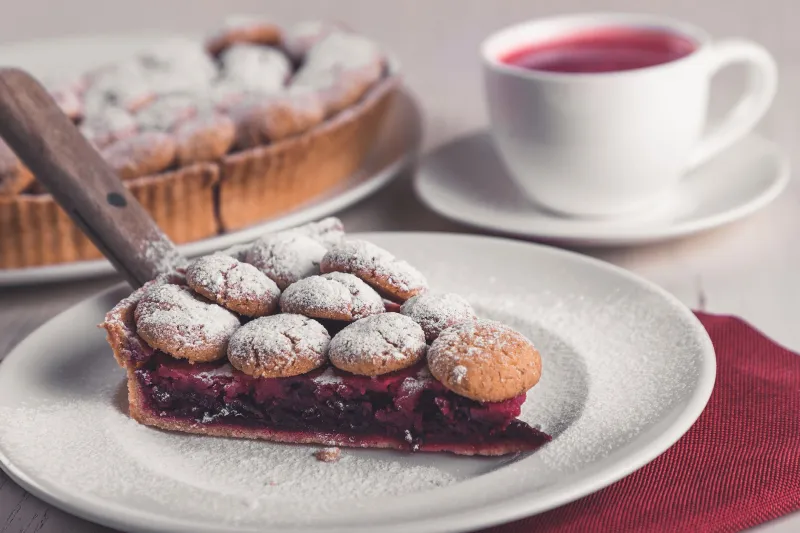
There is a specific kind of British certainty that arrives halfway through a Bakewell tart. Not the loud sort you get from a well-argued pint, but the quiet, settled sort: this is right, this is Derbyshire, this is what a Sunday afternoon tastes like. And then somebody says the words "shop-bought" and the room divides neatly in two.
So we did the thing properly. Six supermarket versions, bought on the same drizzly morning, sliced cold, plated blind, and handed round with one large pot of tea and a notebook. Then, because blind tasting can only tell you so much, we drove out to a village bakery and bought a slice that was still warm through the middle, wrapped in paper, and ate it standing up on the pavement like absolute professionals.
Here is what we learned. Spoiler: it is not the expensive one.
Five Things We Argued About
Blind tasting a tart is silly until it suddenly isn't. We settled on five measures, and then spent twenty minutes renegotiating two of them.
The pastry. Short, buttery and thin enough to disappear. A Bakewell with a biscuity slab underneath is a Bakewell that has given up.
The frangipane. This is the whole argument, really. It should be damp but not wet, generous but not cloying, and it should taste of almonds rather than of almond essence, which is a different and much louder beast.
The jam. Raspberry, sharp enough to cut the butter. Too little and the tart is a sad almond sandwich; too much and the whole thing slides.
The icing. Here the country splits. A thin, barely-there drift of icing is one school; a thick white lid is the other. We were, broadly, thin-icers.
The cherry. Yes, glacé. Yes, we know it's traditional. No, we still couldn't agree.
The Six, Briefly
The value pack. Two tarts for barely over a pound. Sweet, soft, jam doing an enormous amount of work to cover up a fairly thin frangipane. Not a tart to sniff at, but not a tart to talk about either.
The standard own-label. The most middle-of-the-road slice of the day — pleasant, a bit pale in the pastry department, and gone from the plate quickly, which tells you something.
The discounter's version. Genuinely the surprise of the morning. Better frangipane than its price tag has any right to buy, decent almond flavour, a little heavy-handed with the icing.
The premium own-label. Good butter pastry, clearly a better class of baking, and then the jam arrived stiff and slightly too sweet, sitting on top like it had somewhere else to be.
The all-butter one from the posh end of the aisle. Best pastry by a distance. Lovely colour, proper crisp edge. Undone by almond extract turned up one notch too far — that marzipan-loud, faintly soapy note that follows you around the rest of the afternoon.
The boxed "artisan" one from a farm shop. The most expensive tart we tasted and, sadly, the driest. Beautiful packaging. Pastry with the texture of a good shortbread that had been left out for a day and a half. Nobody finished it, and nobody said so out loud.
Which leaves the winner of the supermarket round. It was the discounter's — unglamorous, slightly over-iced, and honest about what it is. Second went to the premium own-label on pastry alone, but a tart is not a pastry case, and the frangipane is where the votes were won.
The Warm Slice Problem
And then the village bakery.
A small shop at half nine, a tray just out of the oven, a slice cut and bagged while it was still giving up heat. Two pounds eighty. No box, no ribbon, no story on the label.
It was not perfect. The icing had slid slightly. One corner was darker than its neighbours. The cherry was, in our considered opinion, still unnecessary.
It was still the best thing we ate all morning by a country mile.
Warmth does something that no recipe tweak can fake. It wakes the butter up, sends the almond smell straight across the room, and turns frangipane from a slice of cake into something closer to a custard. The jam loosens. The icing softens to a glaze. Cold supermarket tarts are judged on politeness; a warm slice is judged on whether you want a second one before you have finished the first.
That is not a fair fight, and it is not meant to be. The bakery did not win because it was more expensive or more traditional. It won because it had not been sitting in a plastic tray since Tuesday.
A Note on the Pudding
Worth saying, gently, for the sake of family harmony: the Bakewell tart and the Bakewell pudding are not the same thing. The pudding is the older relative — puff pastry, an eggy almond-and-jam filling, sometimes served warm with cream, with a story attached to a 19th-century inn kitchen that nobody can quite verify. The tart is the modern, tidy, shortcrust-and-frangipane version most of us grew up with. Both deserve a plate. Please do not start this at Christmas.
What Actually Deserves the Weekend Tea Table
If you are feeding a crowd on a Saturday afternoon and there is already a lot going on, buy the cheap ones, warm them through for six or seven minutes at 160°C, and do not apologise. A warm modest tart beats a fridge-cold posh one every single time.
If there are four of you and a proper pot of tea, the discounter's slice is the one we would take home again. It gets the frangipane right, which is the only bit that really matters.
And if you happen to pass a village bakery with a tray out on the counter, buy the slice. Eat it on the pavement. Buy a second one for the walk home.
The best Bakewell tart in Britain, it turns out, is not the fanciest. It is the one that has not yet cooled down.